Physical And Mental Health Industry Trends: What The App Market Tells Us
It has been year and a half since the COVID-19 pandemic has started. It resulted in higher levels of depression and anxiety, as well as in a lack of opportunities to stay active. Are the changes in mental and physical health caused by all these issues irreversible? To answer this question we decided to conduct a research based on the dynamics in the app market.
— by Diana Levintova

One and a half years ago it hit us: the pandemic spread across the world, leading to less or more stringent lockdowns. It resulted in higher levels of depression, anxiety and clashing with family members, as well as in a lack of opportunities to stay active, visit sport centers or attend favorite training sessions. We asked ourselves: were the changes in mental and physical health caused by all these issues irreversible? How has human behavior evolved in this regard once it started to look like the pandemic would soon be over?
To tap into the phenomenon, we decided to look at the USA in detail: in this country, events such as the imposition and lifting of the lockdown, the first, second and third waves of the disease, etc., occurred in relative sync. Moreover, by conducting research based on data for one big country (and not a group of countries), we can count on trends in mental and physical health to be more narrow and unidirectional.
Firstly, let’s check which apps in the field of mental and physical health were in demand in the USA over the last few years and if their aggregate popularity has changed.
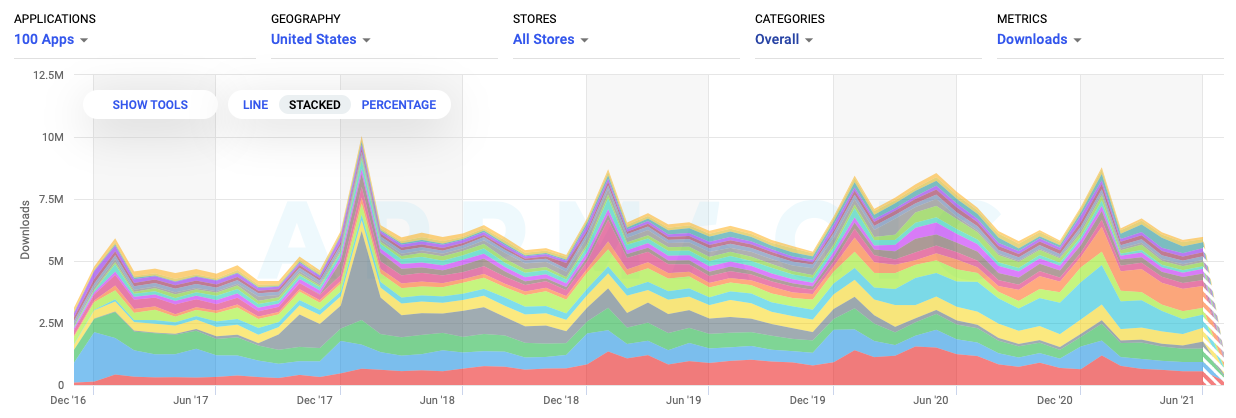
Now, this is rather descriptive, isn’t it? We can easily identify the yearly seasonal trends with sharp spikes in January, plateaus until fall and the defined downtrend around Christmas and New Year holidays, with fresh resolutions being sworn for the upcoming year. In 2020, the January spike is comparatively lower than in the previous years. However, between spring and fall, the graph bulges up, which is exactly the time when the pandemic-related anxiety peaks: lockdown is established; all public places are closed; social deprivation is coming; no vaccine is yet available, and no one knows when it will be.
Hence, there is a noticeable deviation from the yearly trend that is typical for apps of this segment: their popularity is higher than usual. What is happening next, though? From the middle of 2020, we find a drastic downtrend all the way to the level of 2019 and even lower. The bulging of the plateau can possibly be explained by the public’s reaction to COVID restrictions; however, the question still stands about why the trend mellowed out—despite the fact that lockdown restrictions in the USA were only lifted in June 2021.
Either way, the top of physical & mental health apps is not homogeneous; there are apps of various types. Let’s look at each in more detail.
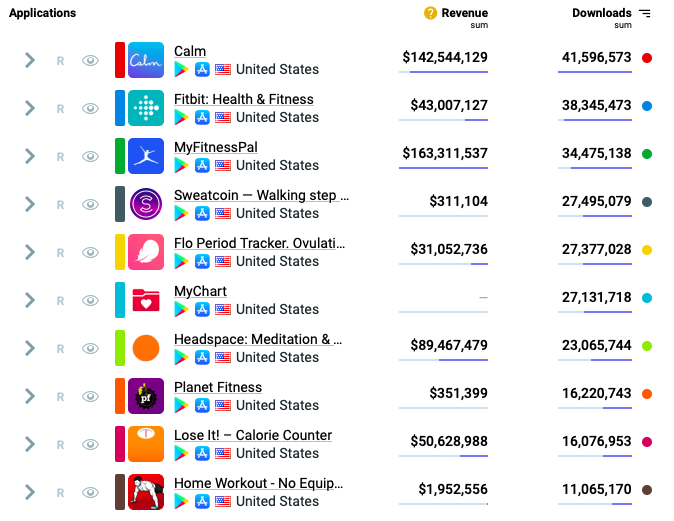
It is fairly straightforward that we can outline 5 major app categories in this segment: weight control, workouts, meditation, period tracker and pregnancy tracker. The last two are not exactly viable in our research because it would be stretching it to imply that COVID-19 had a major effect on periods or pregnancy. Therefore, we are removing them from further consideration, proceeding with the three remaining segments and looking at them closer. Let’s start with the weight control category, as it has the highest total number of downloads, and then move on to workout and meditation.
Weight Control
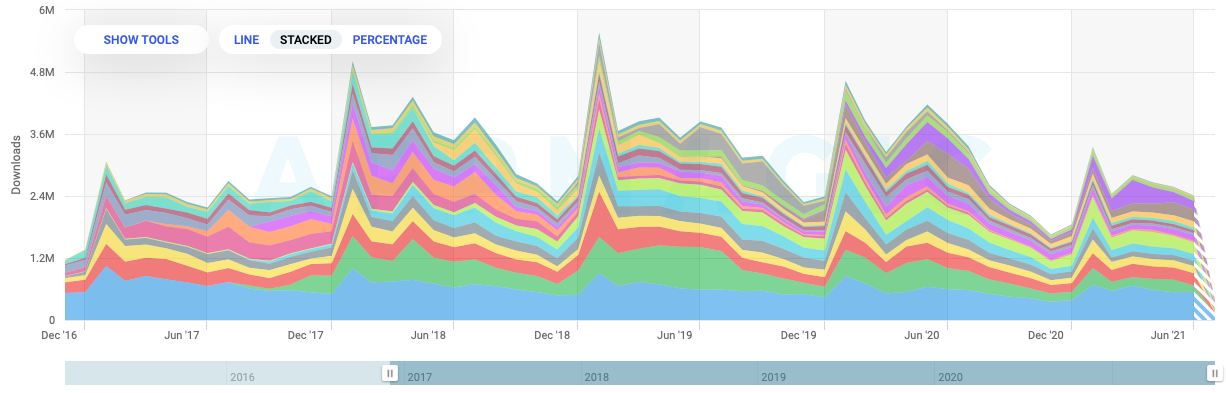
The general trend can be detected here just as well: same spikes in January and an overall decrease in interest in the segment for the country. However, what is intriguing is that the spike in 2021 was not as prominent as it was in the previous years; that can be linked to the lack of motivation to diet, since people spent most of their time at home and there were fewer others to judge or comment on their bodies. Also, the graph bulges up in the spring and summer periods, which may be associated with the COVID-19 effect on the increase of stress-eating, comfort food consumption and food consumption in general; these, in turn, would have led to people becoming even more preoccupied with their weight. However, in the fall, there is a sharp decline in downloads, and from then onwards their level has remained below the average level of the three previous years, lingering around the metrics of 2016. Seems like the USA citizens decided to let go of weight issues, choosing either to enjoy life in the period of world crisis or to prioritize different problems for the time being.
Workourts
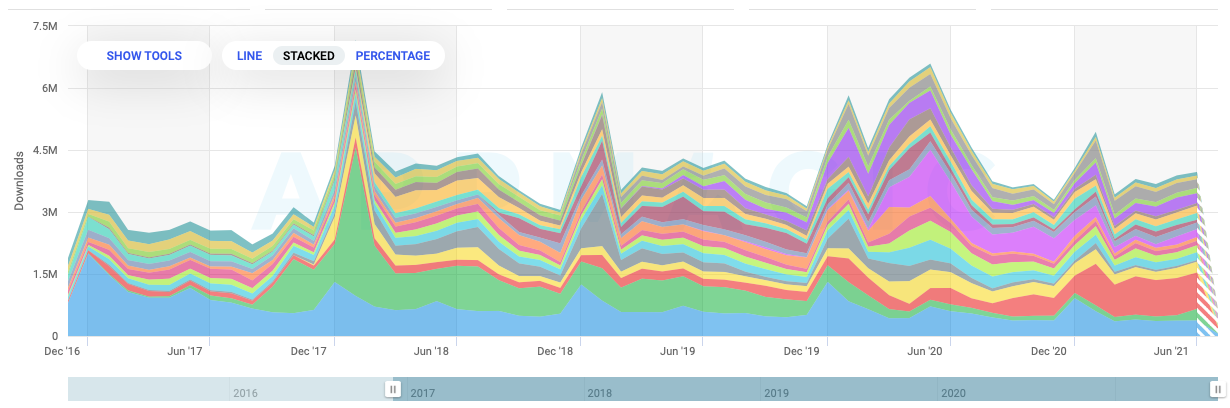
Another similar app segment is training and fitness. What we could expect is a trend similar to the one in the weight control segment. However, what we actually see is that the interest in fitness apps did not decrease compared to the previous years after its massive spike in the spring and summer of 2020. To be fair, there is no growth either: the USA was in lockdown until June 2021, and going to the gym was impossible. The reason must be that some people that were into sports before the pandemic may have stopped, while some others, on the contrary, started training at home or outdoors.
Meditation
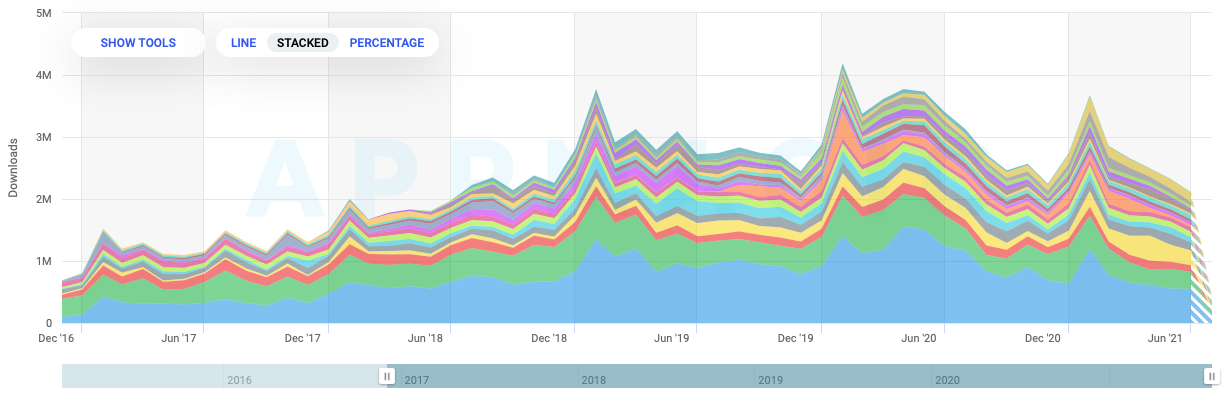
Yeah, finally something spicy. From the first look, we see that the popularity of meditation apps has noticeably increased since 2018. In 2020, we observe a standard spike in January, after which a striking increase in interest in the segment occurs, which can certainly be linked to COVID-19 implications (decrease in relationship satisfaction, growing divorce rates, lower percentage of new successful marriages); however, it nearly leveled out by the end of 2020. Interestingly, the graph correlates poorly with the statistics on anxiety and depression disorders: in both cases, there were two major spikes in summer 2020 and winter 2021 in step with the two waves of the pandemic. We can conclude that mental health apps were not the number one go-to tool for resolving the aforementioned issues. Eventually, the downloads in 2021 fall back to the level of 2019; moreover, we see an actual downtrend. We should keep in mind that the global market has grown over the past 2 years, so the apparent stagnation in the genre manifests an actual fall. To put it simply, lockdown has not really provoked any visible increase in popularity of mental health practices.
Let’s now briefly refer to Asia. What is happening in the three major markets of the region: China, Japan and Korea?
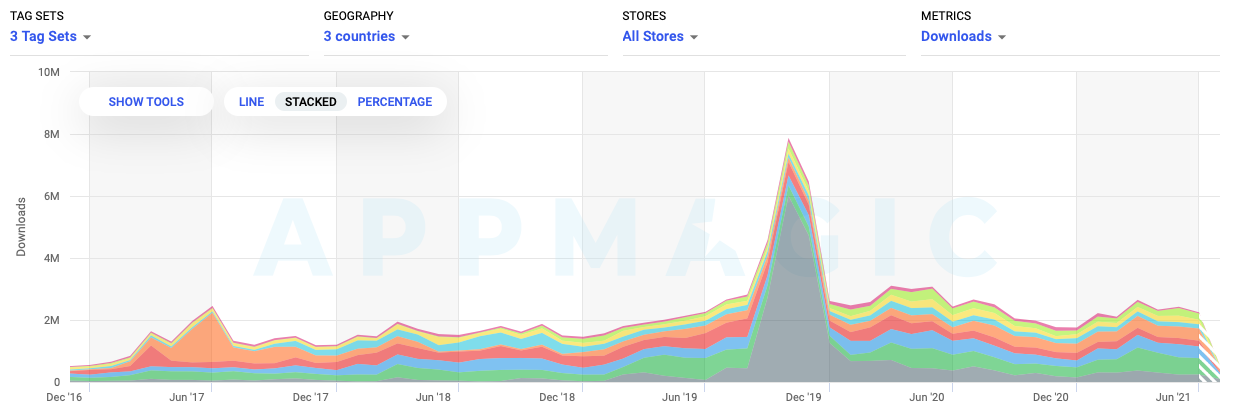
In 2019, there was a big surge of interest in the 步多多-记步运动软件助手 app that counts daily steps, offers training routines and estimates calories spent during specific daily activities. However, except for this spike, there seem to be no exciting changes at all.
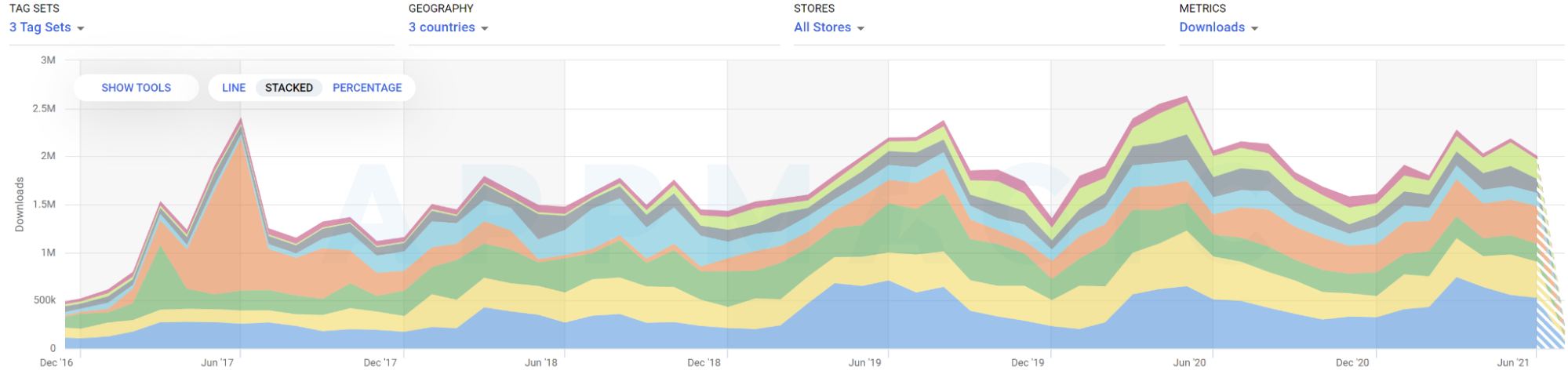
To confirm that, we are removing 步多多-记步运动软件助手 from the set. What we see is that nothing major is happening with the apps for physical and mental health: the graph indicates that the situation in Asia has barely evolved.
In a nutshell, COVID caused some turbulence in the spring and summer of 2020, but it has not led to any serious changes in the field of physical and mental health practices. Looks like whoever did it before, continues to, now; and those who were not major sports goers earlier are yet to shift their lifestyles and daily routines. And, admittedly, behavior trends for those who work out and/or meditate without using any apps whatsoever are beyond the scope of this research.